

How Great Marketing Teams Are Actually Built
What changes when you stop scaling output and start scaling leverage

Most marketing teams don’t struggle because they lack talent.
They struggle because the system around that talent quietly works against them.
I’ve seen this pattern repeat itself across very different environments. I saw it at Webflow as we upleveled the team and fundamentally changed how marketing operates in a world of AI. I saw it earlier at Affirm, when marketing moved from what were effectively random acts of execution to a data-science and predictive-driven growth engine built on true incrementality. And I continue to see it now in advisory work, as AI reshapes how companies are discovered, evaluated, and chosen.
Different companies. Different stages. Same underlying dynamic.
When growth feels fragile or stalled, the instinct is almost always the same. Add people. Add programs. Add pressure. The assumption is that effort is the constraint.
It rarely is.
What’s usually constrained is leverage.
Modern marketing didn’t become harder because marketers became worse. It became harder because the environment changed faster than the way most teams are built to operate. Buyers don’t move through clean funnels anymore. Discovery happens long before you ever see it. AI collapses research and consideration into answers. Channels fragment. Weak signals matter more than obvious wins. And budgets, especially at scale, no longer tolerate inefficiency disguised as experimentation.
In that world, output is abundant. Impact is scarce.
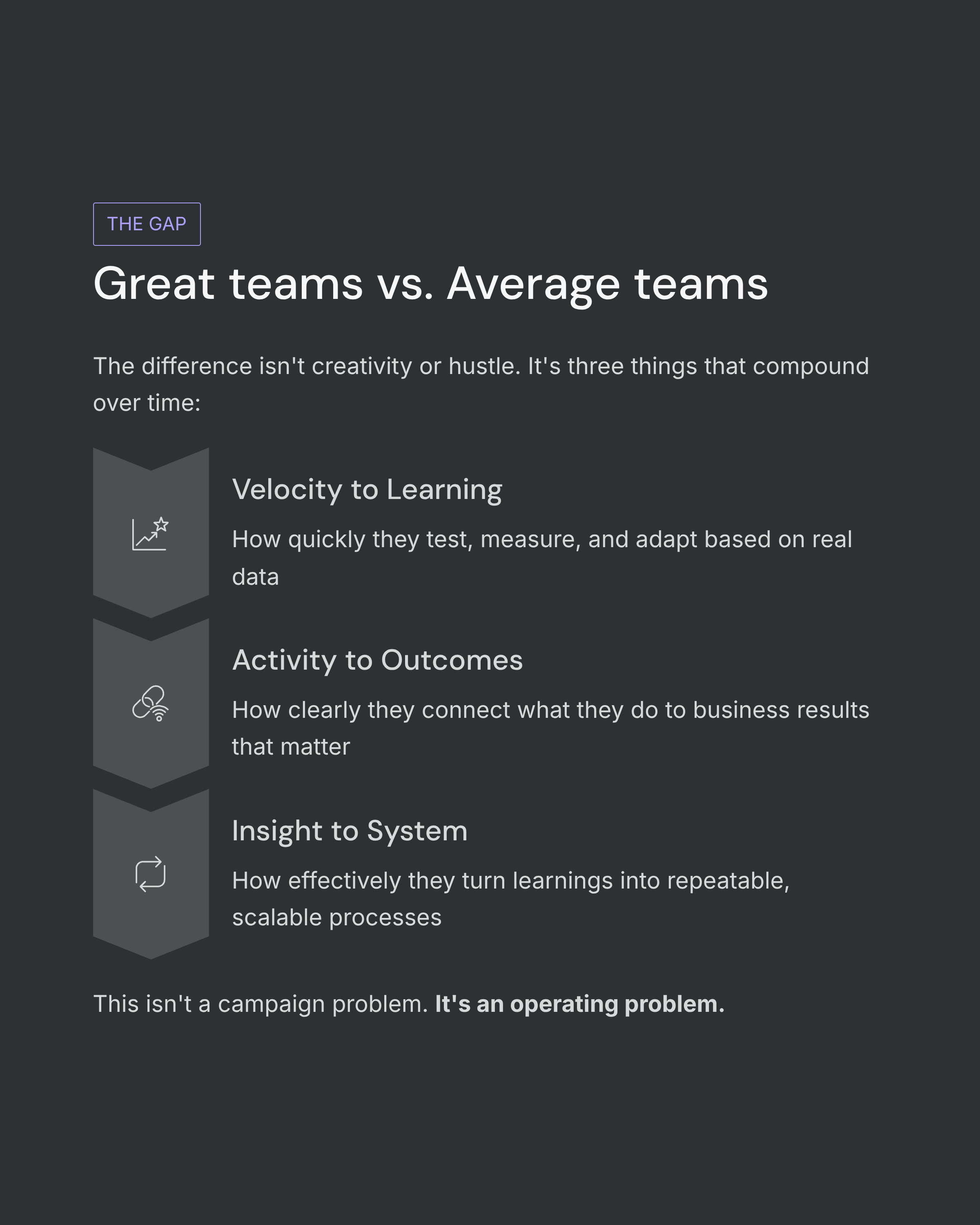
The difference between average marketing teams and truly great ones isn’t creativity or hustle. It’s how quickly they learn, how clearly they connect activity to outcomes, and how effectively they turn insight into something repeatable. That’s not a campaign problem. It’s an operating problem.
Most marketing organizations are still structured around functions instead of outcomes. People “run SEO,” “own content,” or “manage campaigns,” while the business actually needs acquisition, influence, and durable demand. Strategy lives in decks. Execution lives in sprints. Learnings flash briefly in Slack before disappearing. Everyone is busy. Very little compounds.
What great teams do differently is subtle, but decisive.
They stop optimizing for perfection and start optimizing for velocity to learning. They make experimentation cheap and obvious. They automate anything that repeats. They collapse the distance between insight and action. AI isn’t treated as a novelty or a side initiative, but as a way to compress time between idea and impact.
At Webflow, upleveling the team didn’t come from adding headcount. It came from redesigning where human judgment mattered most and where systems should carry the load. As we rebuilt how content refreshes, intent prediction, and experimentation cycles worked, velocity increased dramatically without growing the team. The work didn’t get louder. It got more precise. People spent less time coordinating and more time deciding.
At Affirm, the shift was even more explicit. Growth unlocked when marketing stopped being a collection of activities and became a predictive system. Decisions were grounded in incrementality, not attribution theater. Models guided where to invest, where to pull back, and where marginal effort actually produced marginal returns. That change didn’t just improve performance. It changed how marketing was trusted inside the company.
Across both environments, and now repeatedly in advisory work, the lesson is consistent: headcount is no longer capacity. Systems are. A small group of strong operators, equipped with automation, clear ownership, and tight feedback loops, will consistently outperform much larger teams running legacy playbooks.
This is why transforming a marketing team is not a creative exercise. It’s a leadership one.
You don’t do it by hiring someone with better ideas. You do it by hiring someone who can redesign the environment those ideas flow through. Someone who understands incentives, constraints, and tradeoffs. Someone who knows when to push for speed, when to slow down for clarity, and when to kill something without nostalgia.
Modern marketing leadership is less about inspiration and more about architecture.
When the system is right, people do the best work of their careers. Judgment replaces coordination. Wins get systematized. Losses turn into learning instead of blame. Visibility becomes a growth input instead of a vanity metric. The team stops feeling busy and starts feeling effective.
When the system is wrong, even exceptional talent looks average. And no amount of hustle fixes it.
The uncomfortable truth is that the bar for marketing has moved, and many organizations haven’t moved with it. They’re still trying to win modern markets with structures designed for a different era.
The companies that win over the next decade won’t do so by running more campaigns or building larger orgs. They’ll win by building marketing machines that scale judgment, speed, and learning. Machines that get stronger with use, not more expensive.
Great marketing teams aren’t built by doing more.
They’re built by building leverage.