

Hard truths of a marketer stepping into 2026
Marketing didn’t slowly change. It quietly crossed a line.

Most teams are still operating on instincts, metrics, and playbooks that made sense in 2018 (or even 2022). They still work just enough to feel safe. But not enough to actually win.
Here are the truths marketers are going to have to confront heading into 2026.
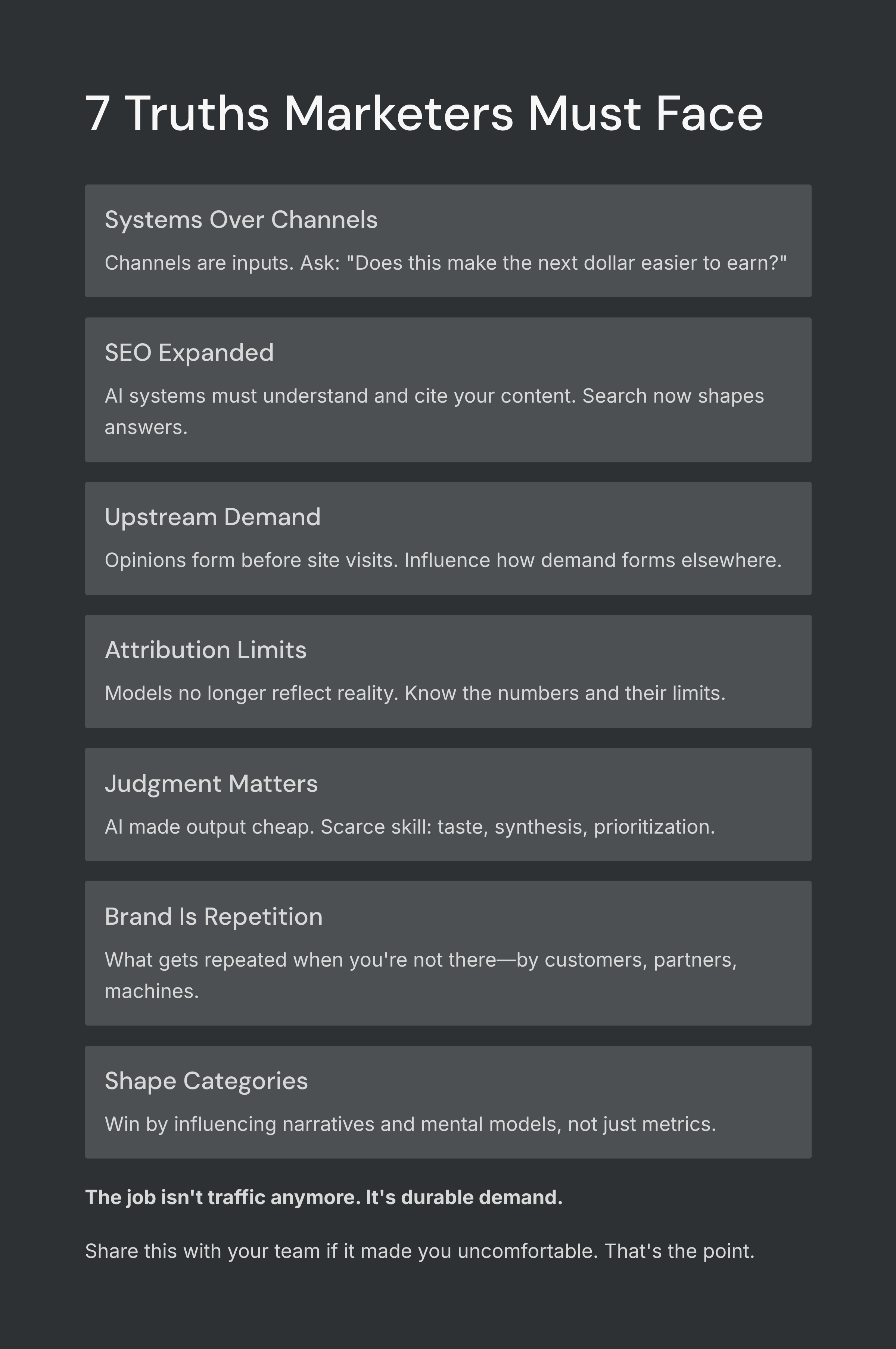
1. Marketing isn’t channels anymore. It’s a system.
Channels are inputs. Outcomes come from how the system works together.
If your efforts don’t compound, you’re not building growth. You’re creating motion. Activity without accumulation. Campaigns without carryover.
The teams that win aren’t asking “Which channel performs best?”
They’re asking “Does this make the next dollar easier to earn?”
2. SEO didn’t die. It expanded.
Rankings still matter. Traffic still matters.
But what matters more is whether AI systems understand, trust, and repeat your point of view.
Search used to be about clicks.
Now it’s about shaping answers.
If your content can’t be extracted, cited, and summarized by machines, you’re invisible in the fastest-growing discovery layer on the internet.
Check out my full AEO guide here.
3. Demand is being formed before buyers ever touch your site.
By the time someone lands on your homepage, their opinion is already shaped.
AI tools, peer conversations, communities, and platforms increasingly do the educating upstream. Preference is formed elsewhere. You’re often just the validation step.
That means marketing’s job isn’t to “create demand” at the point of entry.
It’s to influence how demand forms before you ever see it.
4. Attribution didn’t break. It just stopped explaining reality.
We still use attribution because it gives comfort. It gives clean charts. It creates the illusion of control.
But it no longer reflects how decisions are actually made.
Buyers move non-linearly. Influence is distributed. Machines mediate discovery. And yet we keep forcing complex behavior into simple models because uncertainty makes organizations uncomfortable.
Good marketers know the numbers.
Great ones know their limits.
Check out my 2026 zero click playbook here.
5. AI didn’t replace marketers. It raised the bar.
AI makes output cheap. Judgment is now the scarce skill.
Teams that optimized for volume, speed, and surface-level efficiency are the ones feeling exposed. The advantage is shifting toward taste, synthesis, prioritization, and knowing what not to do.
The job isn’t producing more.
It’s deciding better.
6. Brand isn’t what you say in campaigns.
Brand is what gets repeated when you’re not in the room.
That includes what customers say. What partners say. What competitors imply. And increasingly, what machines summarize about you.
If AI had to explain your company in two sentences today, would you like the answer?
7. The marketers who win in 2026 won’t manage campaigns.
They’ll shape how the market understands the category.
They’ll influence narratives, mental models, and default assumptions. Not just impressions and conversion rates.
They won’t obsess over traffic for traffic’s sake.
They’ll obsess over durable demand.
The job isn’t traffic anymore.
It’s durable demand.
And pretending marketing hasn’t fundamentally changed is how careers quietly stall.
If this made you uncomfortable, that’s the point.