

AI Traffic Converting Better Than SEO Is the Most Important Signal in Marketing Right Now
And almost no one is interpreting it correctly.

Most conversations about AI traffic are still stuck on the wrong question:
“How much traffic are we getting from AI?”
That question made sense in the early days of SEO.
It makes far less sense in the age of AI-mediated discovery.
Because the real story isn’t volume.
It’s intent.
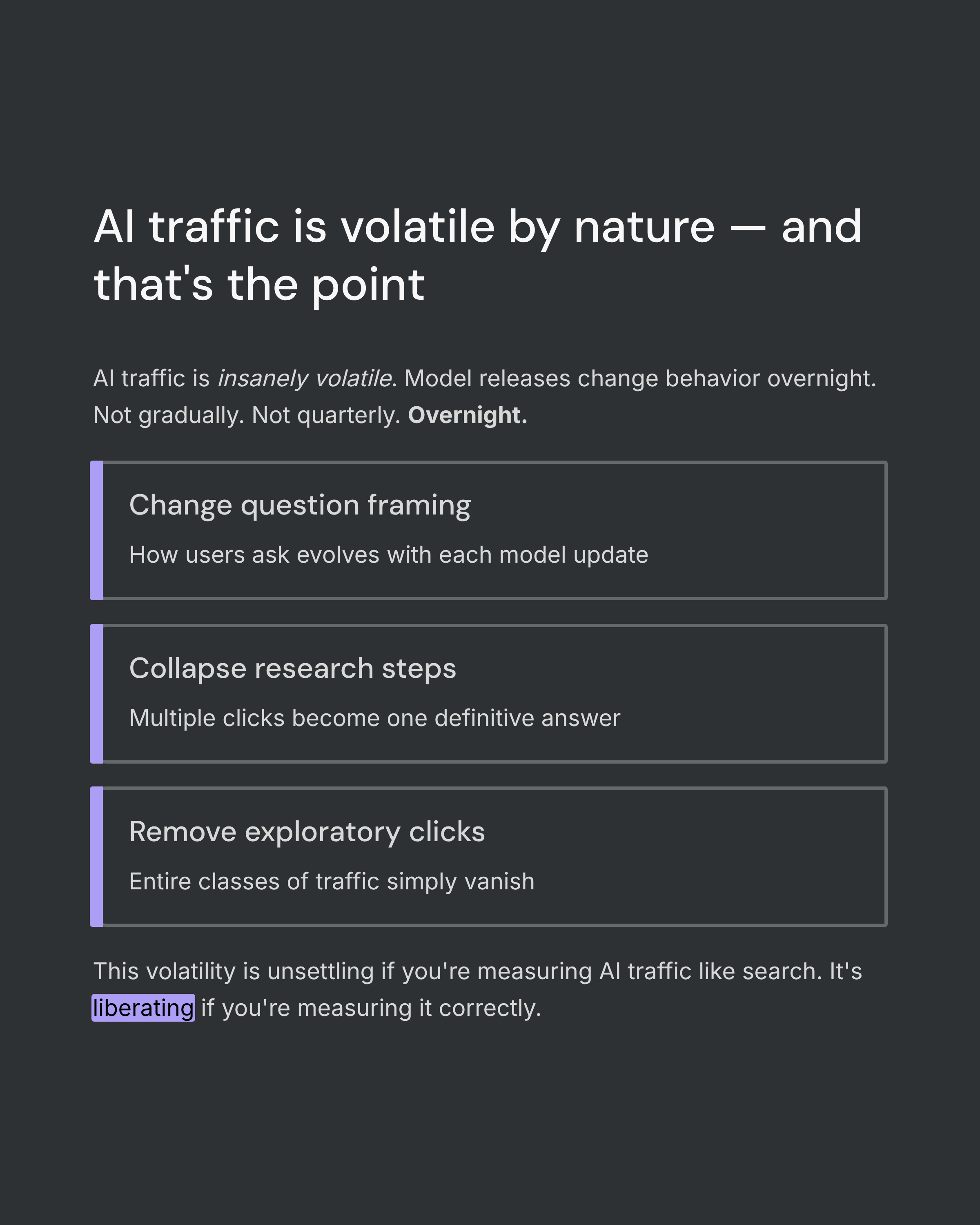
AI traffic is volatile by nature…and that’s the point
AI traffic is insanely volatile.
Model releases change behavior overnight.
Not gradually. Not quarterly. Overnight.
A single release can:
Change how questions are framed
Collapse multiple research steps into one answer
Remove entire classes of exploratory clicks
As a result, volume swings sharply — sometimes without warning.
This volatility is unsettling if you’re measuring AI traffic like search.
It’s liberating if you’re measuring it correctly.
What we’re seeing in practice
At Webflow, we’ve seen this dynamic play out clearly.
After a major model release:
AI chatbot signups dipped
Total AI-sourced volume softened
On the surface, this looks like regression.
But under the hood, something more important happened:
Signup → paid conversion increased +30% month over month (Nov to Dec), outperforming non-brand SEO.
Even more telling:
Users arriving from AI were closer to a buying decision the moment they landed.
That’s the signal.
Why this matters more than traffic growth
AI isn’t a volume channel.
Not yet…and maybe not ever in the way search was.
AI is a high-intent channel that whipsaws with every release.
Which fundamentally changes how it should be evaluated.
Three implications matter most:
Volume is the noisiest metric
It reflects model behavior more than user demand.Conversion quality is the truth
It tells you whether AI is sending decision-ready users.Positioning matters more than traffic capture
If you’re not framed clearly in the model’s worldview, you won’t be chosen.
In other words:
AI doesn’t reward presence.
It rewards clarity.
The funnel inversion most teams are missing
Traditional search and AI do opposite things to funnels.
Traditional search:
Expanded the top of the funnel
Pulled in early-stage curiosity
Stabilized demand through predictable keyword volume
AI-mediated discovery:
Answers early questions before the click exists
Sends users later in the decision process
Destabilizes volume while accelerating intent
Put simply:
Traditional search expanded the funnel and stabilized demand.
AI compresses the funnel and destabilizes volume.
This is why AI traffic can fall one month and still be more valuable than the traffic you lost.
The real competitive advantage
The teams that win in this environment won’t be the ones chasing every fluctuation in AI volume.
They’ll be the ones who:
Expect volatility
Design for intent compression
Optimize for conversion resilience, not traffic stability
They won’t panic when AI traffic dips.
They’ll build systems that convert who shows up, not fantasies about how many should.
Final thought
AI visibility and AI conversion don’t improve by accident.
They’re the result of:
Clear positioning
Structured answers
Tight feedback loops between content, product, and intent
Huge credit to the team pushing this forward.
In a volatile system, durable outcomes are earned — not lucked into.