

AEO is not a channel.
It is a portfolio strategy.

If you are trying to figure out which team “owns” AEO, you are asking the wrong question.
That does not mean AEO lacks ownership.
It means ownership has to be designed intentionally.
The most common question I get right now on LinkedIn is some version of:
“How do I set up my team for this?”
That question makes sense. It just assumes the wrong underlying model.
I usually reach for music analogies when I explain how systems work. This time, no obscure 70s punk band callouts.
I am going to go more financial advisor.
So no, I am not going to call AEO a band.
AEO does not fit cleanly inside a single function, channel, or roadmap. It cuts across how a company explains itself, how the product teaches users, how customers talk about it, and how third parties describe the category.
The cleanest way to understand AEO is to treat it the same way you would treat a financial portfolio.
You do not ask which stock “owns” your returns.
You decide how to allocate capital across assets with different risk profiles, time horizons, and payoff curves.
AEO works the same way.
I have seen this play out firsthand. At Webflow, we have been able to earn roughly 64 percent of answer share in the CMS category while still having relatively low overall market penetration. That gap only makes sense if you stop thinking in terms of channels and start thinking in terms of portfolios.
That is why the only model that holds up is a portfolio model.
Why the channel model fails
Most teams approach AEO with the same reflex they have used for every other growth shift.
Which channel should we invest in?
Is this SEO, content, brand, or product?
Who’s the DRI?
That reflex worked when distribution was observable, controllable, and linear.
It does not work in an answer-driven ecosystem.
Today:
Answers are generated, not clicked
Authority is synthesized across many sources
Trust compounds outside your owned surfaces
Attribution collapses before it ever reaches a dashboard
Once those conditions exist, the idea of a single “owning channel” stops making sense.
AEO does not behave like a channel.
It behaves like a set of answer assets with different risk profiles, time horizons, and payoff curves.
Some assets compound slowly but defensibly.
Some spike and decay.
Hell, some are relevant right up until a model update happens overnight. You can see this clearly with teams that over-indexed on Reddit early and woke up to a very different reality.
Some influence outcomes without ever showing up in analytics.
That is not a channel strategy.
That is a portfolio.
The portfolio mental model
This is the shift.
You have to stop thinking like a channel owner and start thinking like a capital allocator.
In AEO, different answer assets behave very differently:
Some compound slowly but defensibly over time
Some produce fast yield, then decay just as quickly
Some influence trust and preference without ever driving traffic
Some reduce friction in sales conversations without appearing in any dashboard
Each of those assets is valuable.
None of them work in isolation.
When you try to force all of this into a single team, a single channel, or a single KPI, three things happen every time.
You staff the wrong skills.
You measure the wrong outcomes.
You underperform relative to teams that diversify.
The objective is not to win a channel.
The objective is to allocate effort across a portfolio of answer assets that, together, determine how your category is explained.
The AEO portfolio (what you are actually managing)
Whether you formalize it or not, every company already has an AEO portfolio.
Most teams manage it implicitly, which is why it underperforms.
Once you see this portfolio clearly, it becomes obvious why AEO cannot live inside a single channel or function.
1. Owned answers
These are the foundational assets.
They include:
Core website content
Documentation and help centers
Canonical definitions
Structured explanations of how the category works
Their job is not traffic.
Their job is ground truth.
Owned answers establish the language your company stands behind. They anchor how your category is described and give models a stable reference point to pull from.
They are necessary.
They are not sufficient.
If you only invest here, you are building a library and hoping the world shows up.
2. Model-legible explanations
This is where most teams are meaningfully behind.
Model-legible explanations are not written for humans first. They are written to be parsed, reused, and synthesized accurately.
They prioritize:
Explicit definitions
Clear cause-and-effect
Consistent terminology
Reusable framing
The goal is not ranking.
The goal is becoming the explanation models default to when answering questions about your category.
If a model has to explain what your category is, how it works, or which tools matter, and it does not reach for your framing, you do not own the narrative.
If you do not define the category clearly and repeatedly, someone else will.
3. Earned answers
These are the highest-trust assets in the entire portfolio.
Earned answers include:
Customer explanations in communities
Peer recommendations
Third-party comparisons
Unprompted advocacy
These answers convert better than anything you publish yourself.
They are weighted heavily by models.
They are almost impossible to fake at scale.
You do not run earned answers.
You design the conditions that make them inevitable.
This is where product quality, customer experience, and community strategy either reinforce each other or quietly work against you.
4. Product-embedded answers
Every product teaches users how to explain it, whether you intend it to or not.
Product-embedded answers show up in:
Onboarding language
Feature naming
UX metaphors
The explanations users repeat to peers
When customers explain your product accurately and confidently, AEO is already working.
This is the clearest signal that AEO cannot live exclusively inside marketing. Product language, not campaign copy, often determines how your company is explained in the real world.
5. Brand as a trust multiplier
Brand is not a separate asset.
It multiplies every other one.
Brand determines:
Which answers feel credible
Which sources are trusted without verification
Which recommendations require less explanation
Two companies can appear in the same generated answer.
The one with stronger brand gravity is believed.
This is why performance-only AEO strategies eventually stall. Without brand, answers exist. With brand, answers stick.
If you want a deeper dive, I’ve put together a definitive 2026 guide to AEO here.
How to structure AEO ownership without breaking it
This is the nuance most conversations miss.
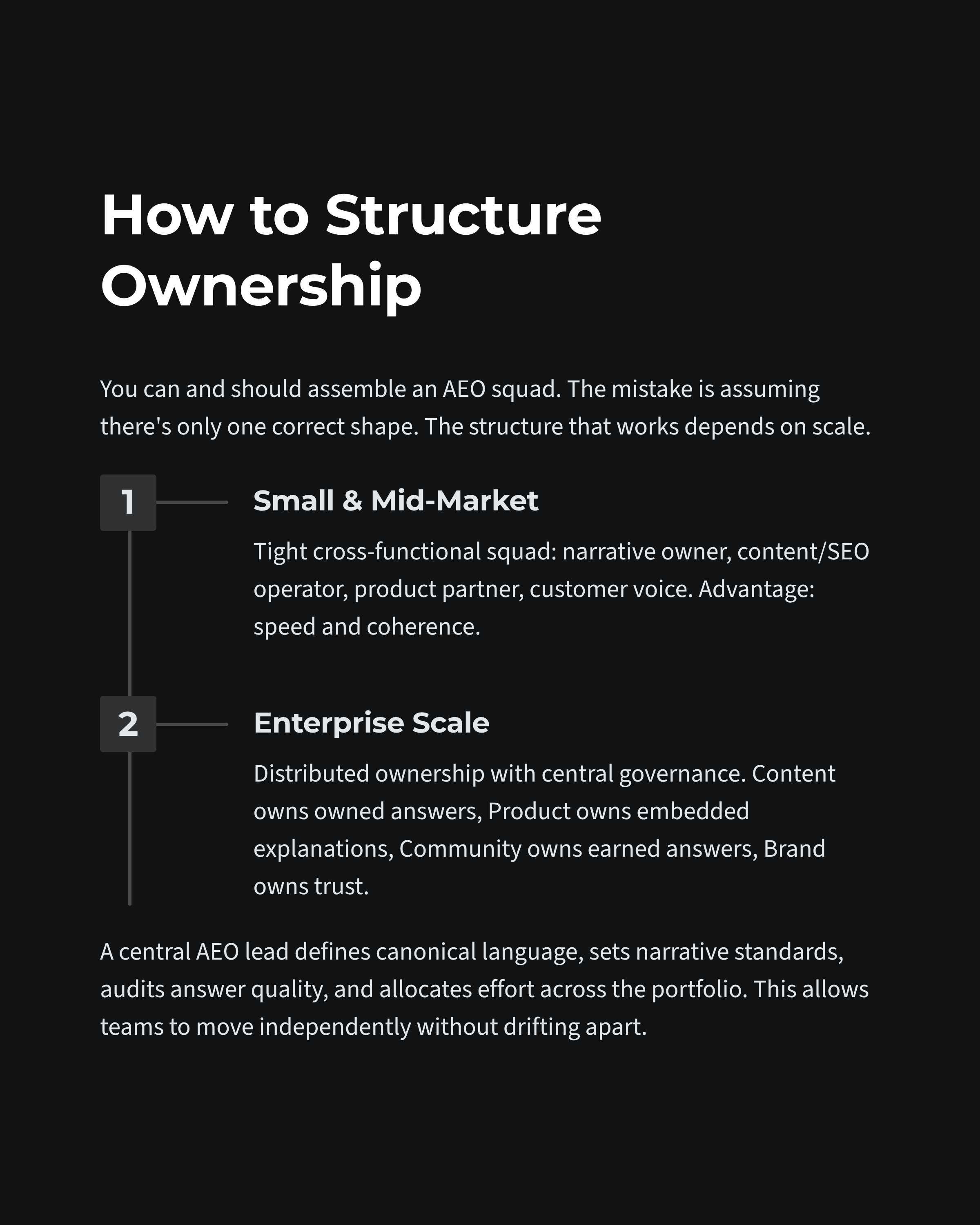
You can and should assemble an AEO squad.
The mistake is assuming there is only one correct shape for it.
The structure that works depends on scale.
Smaller and mid-market companies
At smaller companies, AEO is best driven by a tight cross-functional squad.
Not a department.
Not a reorg.
A small squad with shared accountability.
This squad typically includes:
One narrative owner responsible for language and framing
One content or SEO operator who controls owned surfaces
One product partner shaping in-product explanations
One customer or community voice close to real usage
The advantage here is speed and coherence.
The same people are making decisions across multiple answer surfaces, which keeps the narrative tight and prevents fragmentation before it starts.
Larger and enterprise companies
As companies scale, AEO ownership naturally becomes distributed across channels.
That does not mean it becomes uncoordinated.
At this stage:
Content owns owned and model-legible answers
Product owns product-embedded explanations
Community and advocacy own earned answers
Brand owns trust and consistency
What changes is not accountability.
What changes is governance.
A central AEO lead or small core group is required to:
Define canonical language
Set narrative standards
Audit answer quality across surfaces
Allocate effort across the portfolio
This model allows teams to move independently without drifting apart.
That is the difference between scale and fragmentation.
How marketing leaders need to adapt
AEO forces a role shift for marketing leadership.
Not a skill shift.
A responsibility shift.
Marketing leaders who treat AEO as a channel problem will delegate it and move on.
Marketing leaders who understand AEO as a portfolio problem will change how marketing actually operates.
That distinction matters more than any single tactic.
From channel optimization to narrative ownership
For years, marketing leadership has been optimized around execution.
Leaders were expected to manage:
Spend allocation
Channel efficiency
Conversion rates
Incremental lift
Those skills still matter. They are just no longer sufficient.
In an answer-driven ecosystem, the core question changes.
It is no longer:
How do we acquire demand?
It becomes:
Who defines the explanation of this category?
That is not a channel question.
That is a leadership question.
And it sits squarely with the head of marketing.
Narrative ownership requires:
Consistency over time, not campaign bursts
Cross-functional authority, not influence by request
Willingness to say no to incoherent growth
Patience to invest without immediate attribution
This is why AEO cannot be bolted on. It has to be stewarded.
Head of Marketing/CMO = Portfolio Manager
The modern marketing leader looks less like a channel optimizer and more like a portfolio manager.
They allocate effort the way an investor allocates capital.
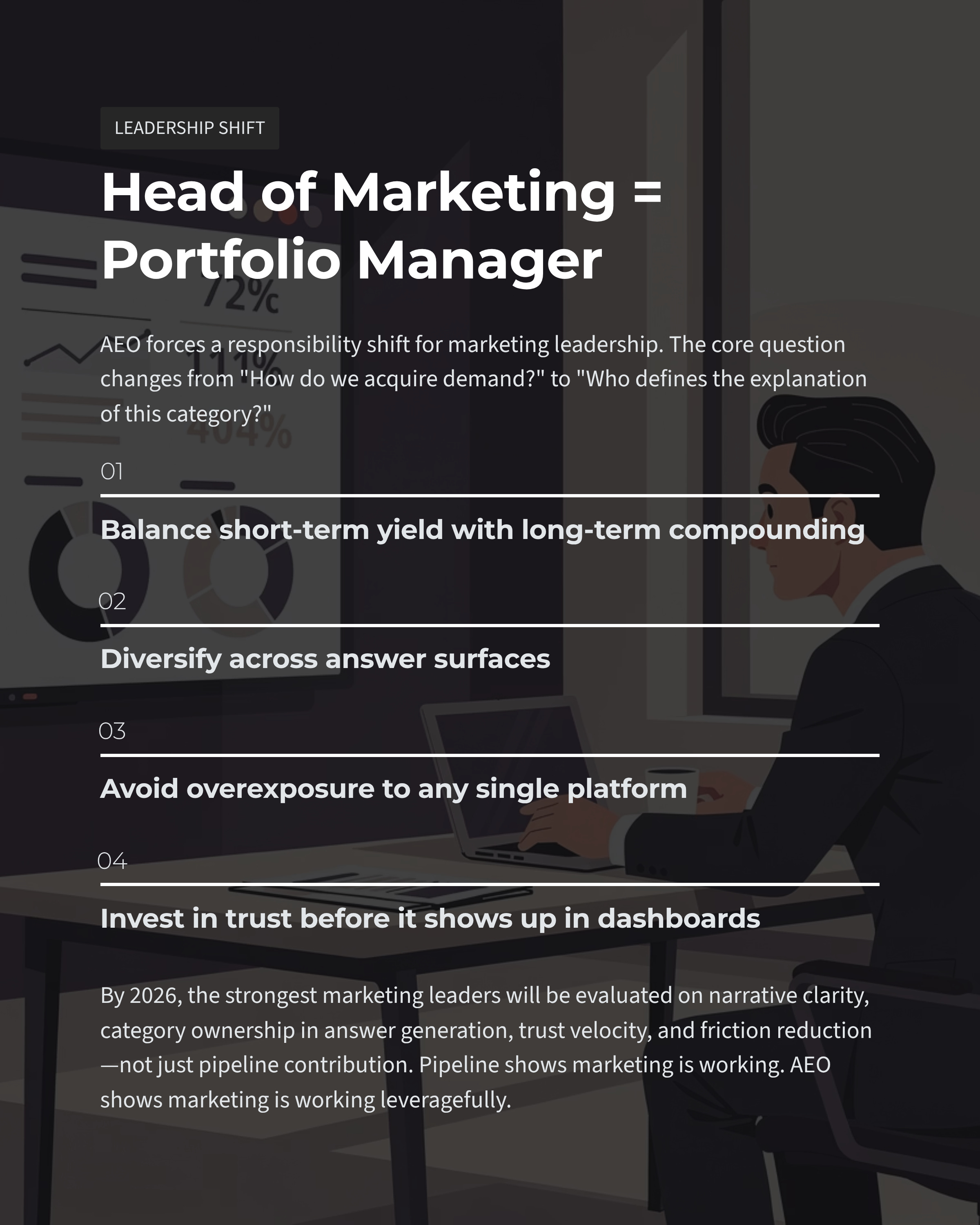
They:
Balance short-term yield with long-term compounding
Diversify across answer surfaces
Avoid overexposure to any single platform
Invest in trust well before it shows up in dashboards
This work does not show up cleanly in weekly reports.
It requires judgment.
Not just dashboards.
The new bar for marketing leadership
Revenue contribution is still table stakes.
It is the price of admission.
Whether that revenue comes through a sales pipeline, a product-led motion, or pure self-serve is secondary. What matters is that marketing creates real, measurable business impact.
But by 2026, the strongest marketing leaders will be evaluated on more than whether marketing can generate demand or drive signups. They will be evaluated on whether marketing makes demand easier to convert, expand, and retain.
That is where AEO changes the bar.
In addition to revenue contribution, leaders will increasingly be judged on:
Narrative clarity across the category
Category ownership in how answers are generated and reused
Trust velocity, how quickly prospects move from awareness to confidence
Reduction in friction across the entire journey, from first question to paid usage, expansion, or closed deal
Revenue shows that marketing is working.
AEO shows that marketing is working with leverage.
This is what raises the ceiling.
AEO does not replace performance marketing.
It compounds it.
Fewer confused users.
Less re-education.
Shorter paths to value.
Higher conviction at the moment of decision.
Less about brute-force volume.
More about explanation that does the work before a sales conversation, a pricing page visit, or a product onboarding flow ever begins.
Once teams experience that shift, there is no going back.
And yes, this is the part where a punk reference usually shows up. Consider this the quiet one before Siouxsie and the Banshees kick back in.
Why this model wins in 2026
Channels will keep fragmenting.
Interfaces will keep changing.
Models will keep updating, sometimes overnight.
That volatility is not a bug.
It is the environment.
Portfolios are how you survive it.
When you treat answers as assets instead of tactics, a few things start to compound whether you optimize for them or not.
Companies that manage AEO as a portfolio:
Compound narrative control over time
Reduce dependence on any single platform or surface
Increase pricing power by becoming the default explanation
Become materially harder to displace, even by better-funded competitors
This is the part most teams miss.
You cannot spreadsheet your way out of ecosystem volatility.
You can only diversify exposure and invest in assets that compound.
That is why the strongest AEO strategies do not look like SEO plans.
They do not chase rankings.
They do not overfit to platforms.
They do not depend on stable interfaces.
They look like investment strategies.
And the companies that adopt that mindset early will not just win traffic.
They will own the explanation layer of their category.
That is the advantage that lasts.
The bottom line
If you are still debating:
Which channel deserves budget
Which team “owns” AEO
Which surface matters most
You are optimizing the wrong system.
AEO is not about winning rankings.
It is about owning the explanation of your category wherever answers are formed.
That cannot be achieved through channel optimization.
It requires portfolio thinking.
The teams that get this will stop chasing distribution and start compounding leverage.
That is the difference between participating in the market and leading it.
Agree mostly. AEO isn’t a channel in the old sense.
But “generated, not clicked” just shifts the bottleneck: models still need a source of truth, and brands can compete to be that source.
The play is simple: publish extractable claims, win third-party validation, and stay entity-consistent across the web.
I find 2 and 4 confusing. Do you have examples of Model-legible explanations and product answers?
The tactical side of seeing AEO as a portfolio isn’t clear for these.